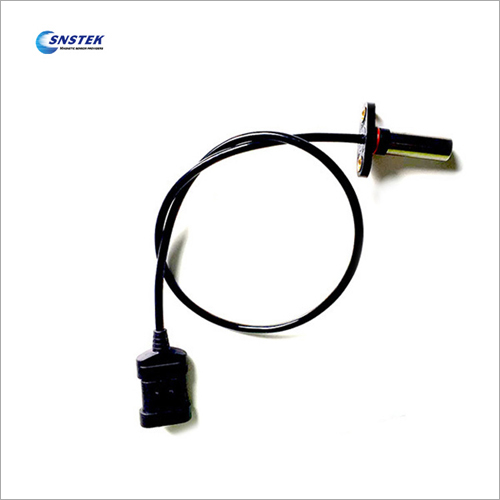
About Magnetic Speed Encoder Speed Sensor
Magnetic Speed Encoder Speed Sensor, we provide have been designed to measure speed in powertrain as well as safety applications such as speedometers, automatic transmissions, camshafts/crankshafts, ABS etc. This is extremely useful for industrial sector. The Magnetic Speed Encoder Speed Sensor makes use of an encoder structure for measuring the rotational & linear speed & position. Made to analyze the rotational speed, the sensor is highly appreciated in assorted applications. The sensor is accessible with many additional benefits such as highest levels of ESD protection as well as integrated capacitors for high EMC robustness.
Technical details
|
Parameters
|
|
|
SDK Part No
|
GTS01 D4P-01
|
|
Product Description
|
Magnetic speed encoder speed sensor
|
|
Sensing distance
|
0.00 - 0.2 mm
|
|
Sensing distance
|
2.0 mm (Recommend)
|
|
Target cogging width
|
2.0 mm (Recommend)
|
|
Gear height
|
3.0 mm
|
|
Gear thickness
|
5.0 mm
|
|
The offset position of the sensor
|
1.5 mm
|
-
Precise and Versatile Industrial MonitoringThis magnetic speed encoder sensor is designed to deliver high detection sensitivity and accuracy for industrial automation systems. Its compact dimensions and customizable cable length enable flexible installation in various machinery setups. Supporting both flush and non-flush mounting, the sensor works seamlessly in conveyor systems, motors, and process monitoring applications. The robust housing and IP67 waterproof rating ensure safe operation even in demanding environments.
Reliable Performance and Easy InstallationFeaturing a rugged construction from ABS or metal, the sensor resists vibration and shock, providing reliable data even in high-impact settings. The M12 connector or cable gland simplifies wiring and integration. With a quick response time of less than 1 ms and frequency handling up to 10 kHz, accurate speed readings are consistently achieved, helping maintain operational efficiency in industrial processes.
FAQs of Magnetic Speed Encoder Speed Sensor:
Q: How do I install the Magnetic Speed Encoder Speed Sensor in my industrial setup?
A: Installation is straightforwardchoose either flush or non-flush mounting, use the included hardware, and connect via M12 connector or cable gland. The standard size fits most machinery, and customizable options are available for specialized needs. Consult the manual for recommended mounting distances to ensure optimum detection.
Q: What environments is this sensor suitable for, considering its durability and resistance?
A: With an operating temperature range of -40C to +85C and storage up to +100C, plus IP67 waterproofing, vibration resistance to 20g, and shock resistance up to 100g, the sensor is ideal for harsh industrial environments such as factories, conveyor systems, and outdoor installations.
Q: When should I use NPN versus PNP open collector output types with this sensor?
A: NPN and PNP output types cater to different wiring and control logic requirements. Use NPN for systems where negative switching is preferred and PNP for positive switching. Refer to your automation setup specifications to select the compatible wiring interface; both 2-wire and 3-wire configurations are supported.
Q: Where can cable length and sensor dimensions be customized for special applications?
A: Custom cable lengths and sensor dimensions can be requested during procurement from the distributor, exporter, manufacturer, supplier, or trader in China. Tailored solutions are available to meet specific space or wiring requirements in complex industrial systems.
Q: What benefits does the sensor offer for automation and machine monitoring applications?
A: The sensors non-contact magnetic detection ensures high accuracy and durability, minimizing wear and maintenance. Its fast response, high-frequency detection, waterproof construction, and flexibility in mounting and customization significantly enhance process control, reliability, and overall automation efficiency.
Q: What is the process for integrating this sensor into conveyor or motor systems?
A: Integration involves mounting the sensor near the target magnetic element within the sensing distance (up to 8 mm), connecting it to the control circuit using the desired output configuration (NPN or PNP), and performing a system check to confirm accurate data transmission. Its standard electrical specifications streamline compatibility with most industrial systems.
Q: Is there a warranty, and what does it cover for this speed sensor?
A: Yes, the sensor comes with a one-year warranty covering manufacturing defects and failures under normal usage conditions. Contact your distributor or supplier for full warranty details and support procedures.


 Send Inquiry





 English
 Spanish
 French
 German
 Italian
 Chinese (Simplified)
 Japanese
 Korean
 Arabic
 Portuguese
 Send Inquiry

 Send Inquiry