About Magnetic Motor Encoder
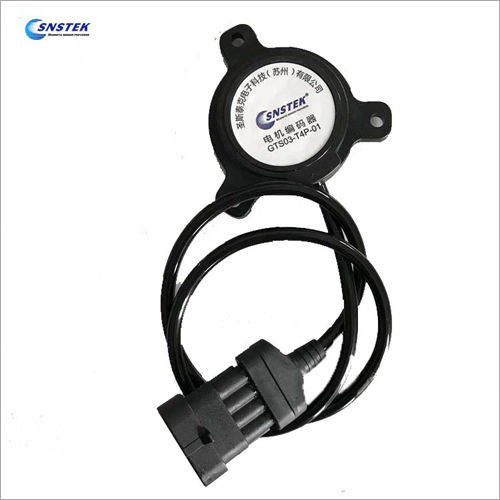
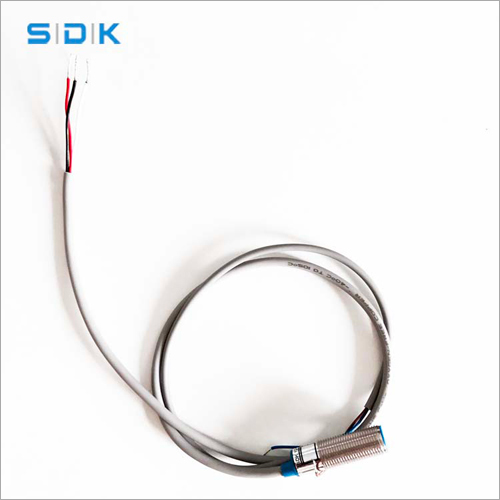
Magnetic motor encoder is a special sort of rotary encoder, which makes effective use of sensors so as to identify the variations in magnetic fields. This is mounted to an electric motor which delivers closed loop feedback indications by tracking the position as well as speed of the motor shaft. Magnetic motor encoder is accessible with robust make and functional design. Its utilization is based on several factors such as motor type and others. It is also vital for the applications that stand in need of mounting configuration and closed-loop feedback.
Technical details
|
Electrical Parameters
|
|
|
SNSPart No
|
GTS03-T4P-01
|
|
Number of Circle
|
64 Dual direction
|
|
Maximum Speed of Rotation
|
10000 rpm
|
|
Phase Difference
|
90deg c
|
|
Duty Cycle
|
50%
|
|
Operating Voltage
|
DC 5.024 V
|
|
Operating Current
|
-30 - +120 deg c
|
|
Operating Temperature
|
-30 - + 125deg c
|
Advanced Sensing TechnologyEquipped with a Hall effect magnetic sensor, this encoder provides high-resolution non-contact detection, minimizing wear and extending product life. The magnetic principle ensures optimal accuracy and performance even in demanding industrial environments. This design eliminates mechanical friction, guaranteeing dependable measurements for rotational position and speed over extended periods.
Industrial Grade DurabilityEngineered for resilience, the encoder resists shocks up to 50G and vibration between 10 to 55 Hz, as per IEC standards. Its ABS housing with an aluminum cover enhances protection, while an IP40 rating provides dust resistance. With versatile mounting options and operational reliability across a wide temperature range, its tailored for tough applications in automation, robotics, and CNC machines.
Effortless IntegrationThe encoder features a standard 1-meter cable, 3 or 4-wire industrial connection, and supports open collector or differential interface, simplifying installation in a variety of systems. Compact dimensions and standard shaft compatibility make it easy to retrofit or integrate with existing motor setups. Its output frequency of up to 100kHz and rapid response time ensure seamless motor control and measurement.
FAQs of Magnetic Motor Encoder:
Q: How is the magnetic motor encoder installed and what mounting options are available?
A: The encoder can be mounted using either shaft mounting or hollow shaft mounting methods, accommodating standard shafts with diameters as small as 6 mm. Installation is straightforward, thanks to its compact design and standard-sized components.
Q: What is the measuring principle of this encoder and how does it benefit users?
A: This encoder uses a magnetic, non-contact Hall effect sensor to measure rotational position and speed. This technology offers maintenance-free operation, eliminates mechanical wear, and ensures high reliability and long service lifeover 10 million revolutions.
Q: Where can the magnetic motor encoder be applied effectively?
A: It is ideal for industrial automation, robotics, CNC machinery, and motor control systems. Its robust build and interface options allow for flexible integration into various high-performance and demanding environments.
Q: What is the typical process for connecting the encoder to a motor control system?
A: Connection is via a standard 1-meter cable using 3 or 4-wire industrial-grade terminals. The encoder outputs A and B phase digital quadrature signals through open collector or differential interfaces, making it compatible with most control hardware.
Q: When should you use this encoder over optical or mechanical types?
A: Choose this magnetic encoder when applications require non-contact operation, resistance to dust and vibration, or when maintenance-free and long life are priorities. It performs well in tough environments where traditional encoders may suffer wear.
Q: What are the benefits of the encoders shock and vibration resistance?
A: Withstanding up to 50G shock and vibration amplitudes up to 1.5mm within 10 to 55 Hz, the encoder is suitable for use in machinery and environments subject to frequent impacts or movement. This ensures stable signal output and long-term reliability.


 Send Inquiry






 English
 Spanish
 French
 German
 Italian
 Chinese (Simplified)
 Japanese
 Korean
 Arabic
 Portuguese
 Send Inquiry

 Send Inquiry
 Call Me Free