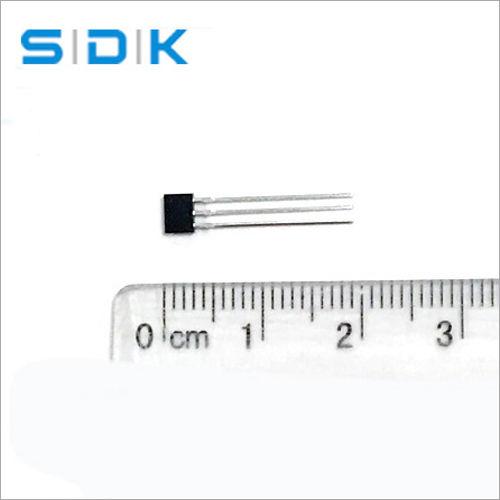
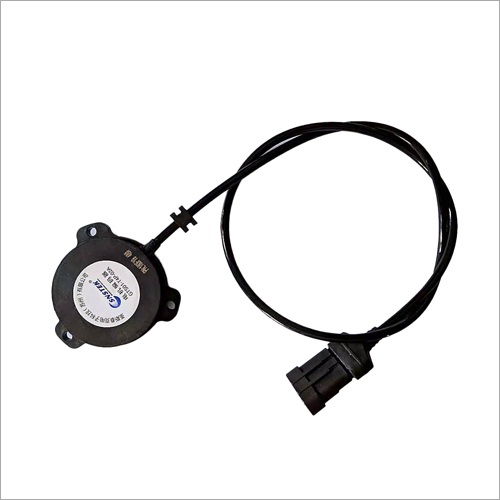
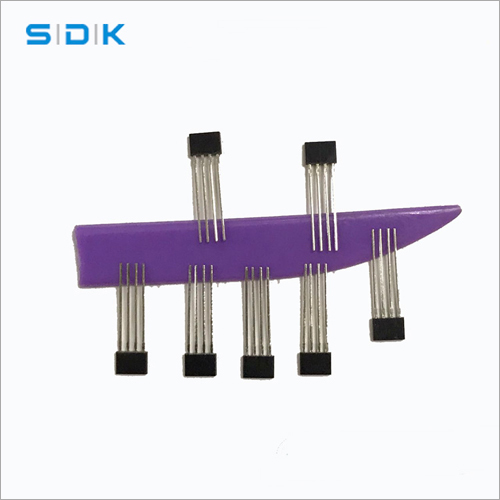
About Bipolar Hall Effect Latch Sensor
Bipolar Hall Effect Latch Sensor we deal in is accessible with a voltage regulator as well as a dynamic offset cancellation system for an efficient operation. In addition, it is featured with open-drain output driver as well as other components, which are all provided in a single package. Due to its extensive operating temperature & voltage range, Bipolar Hall Effect Latch Sensor is highly suitable for its effective usage in BLDC motor as well as automotive applications. It has been designed to identify the magnetic field and boasts of high magnetic sensitivity, CMOS technology and low current consumption.
Technical details
- Model Number:U1881
- Standard Package: 1000PCS/Package
- Operating Voltage Range:3.8V to28V
- Operating Temperature:-40degC to 150deg
- C
- Type: One-chip Hall IC fan driver
- Output: Other, Dual output Hall Sensor
- Usage:Other
- Brand Name: SDK
- Theory:Hall Effect sensor
-
Precise and Reliable Bipolar Latching SensingThe Bipolar Hall Effect Latch Sensor delivers high sensitivity and accuracy for applications requiring alternating magnetic detection. This sensor ensures precise state switching upon exposure to North or South poles, with a fast response time of less than 10 microseconds. Its solid-state silicon design and plastic encapsulation offer long operational life and consistent performance in challenging industrial environments.
Flexible Power and Mounting OptionsDesigned to accommodate various industrial and automation setups, this sensor operates across 3.3V to 24V DC and is available in multiple packages such as TO-92, SOT-23, and SMD. With both through-hole and surface-mounted options, integration into new or existing PCB designs is simplified, making it suitable for a range of applications from rotary encoders to limit switches.
Built-in Protections for Reliable OperationThis latch sensor is engineered with advanced protection features including reverse polarity, over-voltage, and ESD safeguards (depending on model). Its IP50-rated, JEDEC and IEC compliant construction shields the device against dust and environmental hazards, while also supporting a wide storage and operating temperature range, ideal for demanding industrial conditions.
FAQs of Bipolar Hall Effect Latch Sensor:
Q: How does the Bipolar Hall Effect Latch Sensor operate?
A: The sensor changes its digital output state alternately when exposed to North or South magnetic poles. This bipolar latching action allows reliable position or speed detection in applications like motor commutation and rotary encoders.
Q: What are the typical usage scenarios for this Hall Effect latch sensor?
A: These sensors are commonly used for contactless position and speed sensing, switch or proximity detection, and limit sensing in industrial automation, particularly in brushless DC motor controllers and rotary encoders.
Q: Where can I mount the Bipolar Hall Effect Latch Sensor?
A: It can be mounted directly on a PCB using traditional through-hole or surface-mount device (SMD) techniques, fitting into locations where digital magnetic sensing is required without additional wiring.
Q: What protection features are integrated into this sensor?
A: Depending on the model, the sensor includes reverse polarity, over-voltage, and electrostatic discharge (ESD) protection to ensure reliable performance and durability during operation.
Q: When should I use a bipolar latching sensor over a unipolar one?
A: Choose a bipolar latching sensor when your application requires the output state to change only with alternating magnetic poles, such as in commutation or alternating directional detection. This provides greater control and noise immunity.
Q: What are the benefits of using this sensor in industrial automation?
A: Benefits include contactless operation, high reliability, low power consumption, long operational lifespan, and accurate digital output. These factors improve system efficiency and maintenance intervals in automated environments.


 Send Inquiry






 English
 Spanish
 French
 German
 Italian
 Chinese (Simplified)
 Japanese
 Korean
 Arabic
 Portuguese
 Send Inquiry

 Send Inquiry
 Call Me Free